



Nowadays, an LLB graduate has more options available when pursuing admission as a legal practitioner. One of these beneficial options is a 400-hour practical vocational training programme, which enables a candidate attorney to shorten their legal articles and/or apply for admission and enrolment as an attorney earlier.
Let’s explore the different practical legal training options available to LLB graduates and candidate attorneys in South Africa.
Defining the difference between the PVT contract and a PVT programme of structured course work
Practical vocational training (PVT) contract
A PVT contract is also known as “articles”, “articles of clerkship” or “contract of candidacy”. This contract is basically an internship but for the legal industry, and the intern is called a “candidate attorney”.
The PVT contract is an agreement between an LLB graduate and the principal of a law firm, or a person mandated to engage in such a contract on behalf of the law firm.
A candidate attorney only assumes this role and title once they have entered a PVT contract. The PVT contract commences from the date of registration of the contract with the Legal Practice Council (LPC). The LPC will confirm registration in writing and supply a contract number and an LPC number to the candidate.
During a PVT contract, a candidate attorney (also referred to as an intern/clerk) will obtain practical hands-on training at a law firm. The candidate will assume the title and role of a candidate attorney under a law firm, while working for an uninterrupted term as a candidate attorney, earning a stipend. The minimum remuneration has been formalised by the LPC in Notice 2683 of 2024. The candidate attorney is expected to serve their legal training under a law firm or principal for an uninterrupted period of two years (24 months). This training is the traditional two-year PVT contract in terms of Section 27 of the Legal Practice Act read with Rule 17.2.10, 17,3 and Rule 22.
PVT – the contract and the structured course work – is compulsory and is a mandatory legal requirement for admission as a legal practitioner (attorney) in terms of Section 26(1)(c) of the Legal Practice Act, read with Legal Practice Council Rule 22 and LPA Regulation 6.
PVT programme of structured course work
In essence, there are two forms of PVT programmes available. This may also be referred to as “law school”, “practical legal training (PLT)”, “practical vocational training (PVT)”, or “PVT school”.
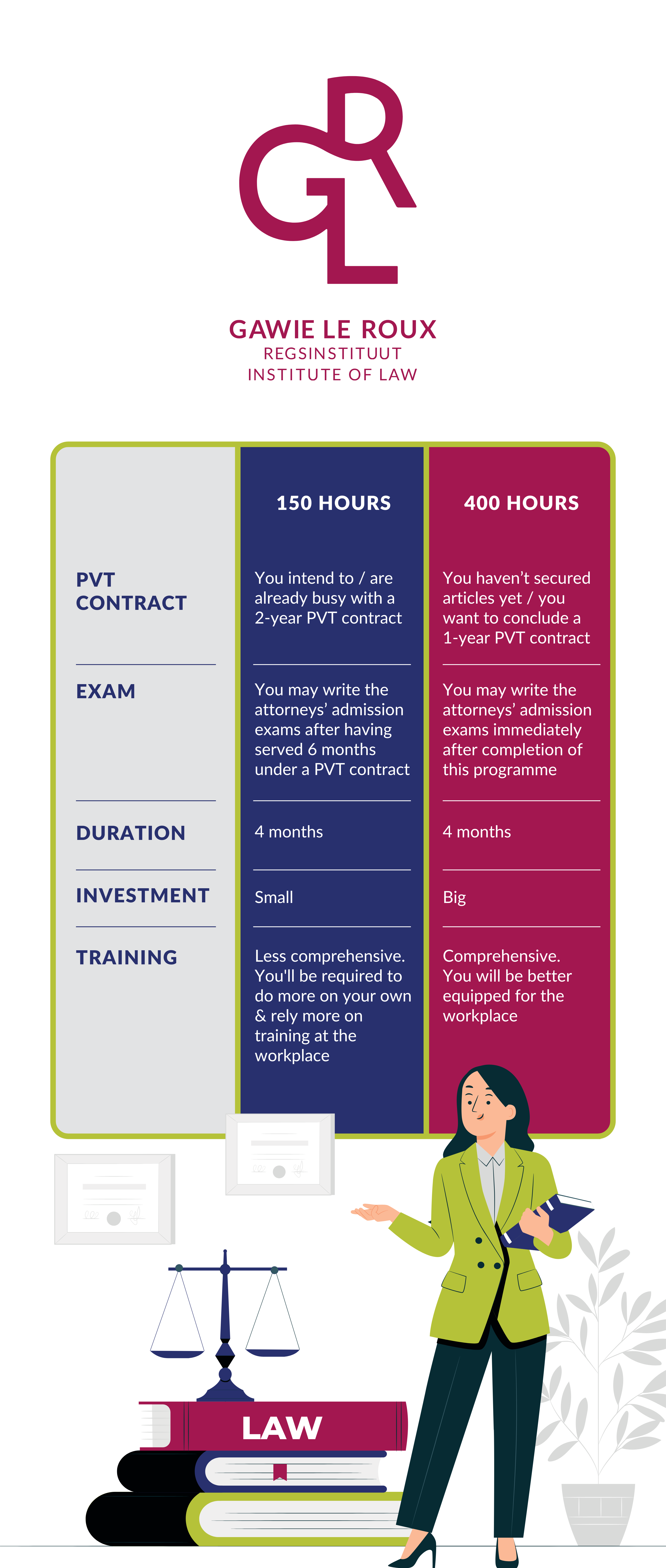
Let’s discuss each route in detail.
150 notional hours PVT programme
This training must not be confused with the PVT contract.
PVT School is a mandatory requirement as part of the attorney admission process in terms of Reg 6(1)(a)(ii). At the Gawie le Roux Institute of Law, this programme is called the 150-hour GLR PVT School.
It is a mandatory requirement that the candidate completes the 150 notional hour programme, IF the candidate has signed a two-year PVT contract within a law firm in terms of Regulation 6. The candidate must complete the 150-hour PVT programme within 12 months after the termination of their PVT contract. The candidate must complete the 150-hour programme if they have not pursued the 400-hour programme. You may choose between a 150- and 400-hour programme of course work, depending on your PVT contract and circumstances; however, completing an LPC-accredited PVT programme is compulsory to become an admitted attorney in South Africa.
400 notional hours PVT programme
This training was previously known as the “400-hour notional PLT”, which created confusion among the legal fraternity. It has now been renamed and is called a “400-hour PVT programme of structured course work”.
Completing a 400-hour PVT programme is not a mandatory requirement for admission. You may choose a 150-hour PVT programme while serving two years of articles. The 400-hour PVT programme is an alternative option if the candidate wants to negotiate a one-year PVT contract with a law firm. That is only one benefit of the more comprehensive PVT programme.
What this means is, a candidate may opt to complete this course and complete a one-year PVT contract within a law firm OR may opt to do this training in addition to being under a two-year PVT contract within a law firm. This training enables a candidate to complete their PVT training sooner by seeking a reduction of the PVT contract from two years to one year.
This intense, practical programme is more extensive in comparison to the 150-hour programme. It runs for four months, depending on the training provider. At the Gawie le Roux Institute of Law, the programme is called the 400-hour GLR PVT School, and both programmes run for four months.
This training assists a candidate in learning the skills and knowledge they would gain at a law firm under a two-year PVT contract. This programme of course work does not replace the completion of legal articles at a law firm in its entirety. Serving articles is mandatory in South Africa; it cannot be avoided.
Purpose of 400-hour practical vocational training
The market is flooded with law graduates, and there are not enough firms that can accommodate the vast number of candidates who need to serve their articles.
Consequently, without the fulfilment of the mandatory practical vocational training contract part of the requirements, a candidate is unable to register to write their attorneys’ admission exams (also called “competency-based examinations” or “board exams”) and thereafter may not pursue their admission as a legal practitioner.
This issue has left many law graduates without a secured PVT contract at a law firm, which has contributed negatively to potential despondency among LLB graduates.
Consequently, the LPC introduced a 400-hour PVT programme in 2018. Its purpose is twofold:
a. to assist LLB graduates who are unable to secure a two-year PVT contract with a law firm; and
b. offers the candidate the option to reduce the PVT contract from two years to one year.
When to pursue a 400-hour PVT programme
The decision is ultimately yours, but there are two scenarios where a candidate should consider proceeding with a 400-hour PVT programme:
Scenario 1:
Where an LLB graduate has not successfully secured a two-year PVT contract with a law firm (yet)
If the candidate can afford a more expensive programme, they may apply to any LPC-accredited law school to complete the more comprehensive 400-hour programme.
Scenario 2:
Where a candidate has secured a two-year PVT contract at a law firm, BUT has opted to shorten the contract by completing the 400-hour programme
In terms of Reg 6(2), if a candidate has served more than one year (12 months) under a two-year contract (24 months) and during that time has completed the 400-hour programme “outside the normal working hours”, then they may register to write the competency-based examinations in terms of Rule 21(1), and if successful, then they may proceed with their application for admission and enrolment as a legal practitioner (Reg 6(2)). The practical benefit is that a candidate may reduce the compulsory two-year PVT contract to just one year.
A candidate must complete the 400-hour PVT outside of their normal working hours (that is, after hours and during weekends). This is to fulfil compliance with the supervision provision in terms of Rule 22.1.3 read with Reg 6(1)(a) and 6(1)(b) as a candidate may not have an interrupted PVT.
The importance of open dialogue with your principal
In this situation, the candidate is required to discuss and inform their principal beforehand that they would prefer to include the 400-hour PVT to pursue a reduced PVT contract. Shortening your articles to a single year is not guaranteed; the candidate must negotiate this with the law firm where they intend to serve articles.
Your principal may grant or refuse your request to conclude a one-year contract. The 400-hour PVT may not be performed during normal working hours if a candidate has signed a contract with a law firm, and this is to preserve the contractual agreement between the parties. Therefore, the 400-hour PVT is done in your own personal time after hours.
It’s good practice to maintain an amicable and courteous relationship with your principal from the start.
It is important to keep your principal informed and to advise your principal when you intend to write the attorneys’ admission exams. This is an important courtesy. Keeping your principal aware of your plans and schedule allows him/her to plan for staff reduction/succession when the candidate attorney qualifies for admission.
A candidate attorney is eligible to write the attorneys' admission exams in terms of LPC Rule 21, read with Section 95(1)(n) and Section 26(1)(d),(2),(3) of the Legal Practice Act.
In terms of Rule 21.11 of the LPC Rules, the following must be completed beforehand.
A candidate may register to write the exams and is eligible to write under one of the following criteria:
- You have already completed the minimum of six months under a PVT contract — without cancellation or interruption, OR
- You completed your two-year PVT contract without cancellation or interruption, OR
- You completed a 400-hour PVT programme, such as the GLR PVT School. You then have access to the exams, even if you have not secured or completed your legal articles yet. (Remember: Even if you pass the exams, you cannot go ahead with your admission application until you have completed your PVT contract), OR
- You’re an admitted Advocate seeking conversion to attorney.
If a candidate writes the examination without complying with Rule 21.11, the examination paper/s will not be marked, no results will be released, and the examination so written will be invalid.
Important: Once the PVT contract expires, the principal may end the employment entirely. The principal is not obliged to retain a candidate whose contract has expired.
Therefore, a candidate may find themselves unemployed until they are admitted to practice. This is the reality, and a candidate must make provision for this possibility.
What are your options when completing a 400-hour PVT programme?
If your situation is as per Scenario 1 above:
Option 1 – Enter into a one-year PVT contract
After completion of the 400-hour programme, a candidate may enter into, negotiate, and conclude a one-year PVT contract instead of a two-year contract Reg 6(1)(b).
The only requirement is that the candidate must register the contract with the LPC by filing the 400-hour certificate of competence along with a signed one-year PVT contract as per the LPC’s requirements.
Option 2 – Register to write the attorneys’ admission exams
After completing a 400-hour PVT programme, a candidate may register to write the attorneys’ admission examinations in terms of Rule 21.11.1.
Yes, this is immediately after completing a 400 notional hour PVT programme and even without having a PVT contract in place. In effect, once you have completed this training, you have completed an equivalent of a one-year PVT contract, and you are eligible to seek a one-year PVT contract.
In other words, if, after doing the 400-hour PVT programme, and a candidate has not managed to secure or negotiate a year’s PVT with a legal firm yet, they may register to write the attorneys’ admission exams in terms of Rule 21.1. Thereafter, when the candidate has passed all the competency-based exams and completed the balance of the mandatory PVT contract (in this scenario, the balance is a one-year PVT contract), he/she may proceed to apply for admission and enrolment as a legal practitioner.
Conclusion
It is possible to utilise an LPC-accredited 400-hour PVT programme of course work to reduce your articles of clerkship from two years to one year. After completing the 400-hour PVT programme of course work, you are still required to complete a one-year mandatory PVT contract with a law firm. Completing the 400-hour PVT programme makes you eligible to reduce your PVT contract from two years to one year. Many rules apply, however, and it is important that you research your options and maintain an open dialogue with your principal throughout the process. Reach out to the Gawie le Roux Institute of Law today!
People also ask
What are the 400-hour GLR PVT School’s admission requirements?
- An LLB degree from a South African university; or
- A law degree in another country, which is equivalent to the South African LLB degree, and which is recognised by SAQA as equivalent. (Please note that confirmation of foreign accreditation by SAQA is the sole responsibility of the applicant); and
- An average of 55% or more in your degree (this requirement may be waived at the discretion of the School’s Principal).
What documents do I need to apply for admission to the 400-hour GLR PVT School?
- A certified copy of your identity document;
- A copy of your academic record;
- A certified copy of your LLB degree (If you do not have a copy of your degree/certificate, you should provide evidence that you complied with the requirements of the degree and when it was or will be conferred. This is often indicated at the bottom of an academic record.)
Why can you write the attorneys’ admission exams immediately after completing a 400-hour PVT programme of course work / law school?
The four-month training is equivalent to one year’s practical training within a law firm; therefore, the rules state that if you have completed at least 6 months of the PVT contract, you are able to write the CBE. The 400-hour PVT programme permits a candidate to write exams immediately after completing the programme, which means that if you pass the CBE, and provided you completed the balance of your mandatory PVT contract, you may proceed with your admission application. This assists candidates in entering the legal profession sooner.
About the author
Angelique Mansour is a Director at Angelique Mansour Attorneys and a Gawie le Roux Institute of Law alumna.
This blog was last updated on 27/10/2025