



Fostering long-term relationships with clients requires more than professional knowledge and expertise. It calls for consultation savvy that includes understanding your clients’ realities and needs, as well as the ability to effectively view each case from different perspectives. This means wearing different hats to apply expert judgment and optimal legal decision-making.
As most legal practitioners undergo very specific tertiary education and professional training, effective client consultation requires a much different competence than simply ticking the career-related boxes. This competence can be developed through gaining self-awareness first, by means of understanding one’s own thinking style best.
The value thereof can be explained as Whole Brain® Thinking. This means being able to seamlessly pivot from different perspectives required to solve a particular problem or case, whilst facilitating a deeper client connection by understanding your clients’ preferred thinking style.
The result: building enhanced client relationships irrespective of different communication preferences, solving problems, and making decisions.
What is the Hermann Brain Dominance Instrument (HBDI)?
This instrument is a scientifically validated assessment tool that identifies a person’s preferred thinking styles across four distinct quadrants. Developed by William "Ned" Herrmann, the instrument maps cognitive preferences (not intelligence or ability) to improve communication, decision-making, and collaboration.
What is the predominant thinking style of legal practitioners?
Below, a collated HBDI profile comprising the average of 13,159 brain profiles in the global database shows the general thinking style of legal practitioners.
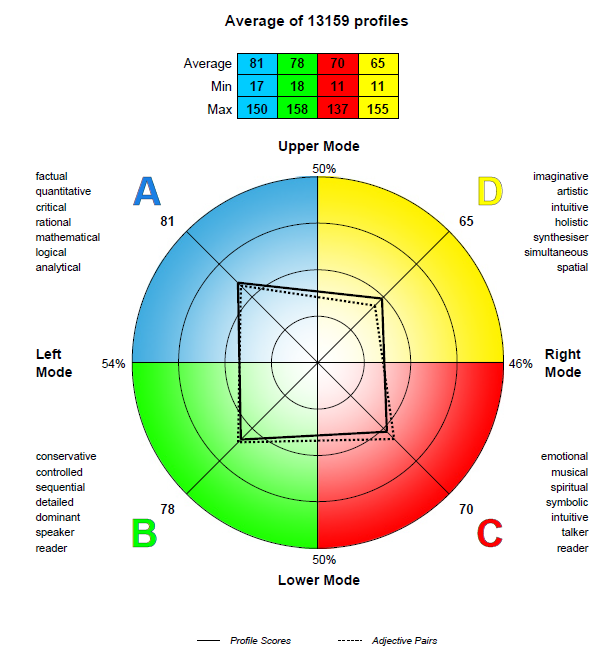
Collated Average HBDI Profile of Legal Practitioners (HBDI, 2016).
Let’s unpack the results.
- Strong preference for the Blue Quadrant: Thinking fact-based, logically, likes to analyse, thinking technically, and prefers a bottom-line approach when solving problems.
- Strong preference for the Green Quadrant: Prefers rules and procedures, likes to organise and plan, and takes a safekeeping approach.
- Strong preference for the Red Quadrant: Thinks feelings and emotions-based, likes to express and build connections with people.
- Medium preference for the Yellow Quadrant: Creative, playful, imaginative, likes to come up with new and novel ideas, and to seek the art of the possible.
As the legal profession is characterised by pressure, legal practitioners are required to maintain their composure in various critical scenarios whilst providing expert legal advice. Under pressure, this HBDI profile illustrates (by means of the dotted line), a Blue and Green Quadrant remaining mostly intact, with a stronger shift towards the Red Quadrant and a Yellow Quadrant shifting to a lower preference.
The implications
The legal practitioner might experience a slight loss of perspective and the bigger picture, whilst feeling the pressure more intensely. This profile also tends to lean toward a true Whole Brain® Thinking style, which means that each quadrant can be considered almost equally during decision-making.
If not understood and managed, lawyers could delay the optimal application of judgment or decision-making. However, this thinking style can become the legal practitioner’s biggest asset when the right quadrant is applied to a specific case or scenario, enabling legal practitioners to effectively meet their clients in the quadrant they mostly prefer.
How to practice effective Whole Brain® Thinking for enhanced client connection
Once legal practitioners fully understand their own thinking style and apply themselves to create the connection, client consultations are facilitated more seamlessly.
Step 1: Practicing self-reflection
Regular reflection on one’s own thinking preferences, applied to various legal and personal scenarios, will increase the self-awareness required for building optimal client connections and relationships.
Step 2: Identify the client’s strongest HBDI quadrant(s) and meet them in their strongest preference
Once your own thinking preferences are understood, others’ thinking styles may become easier to identify in terms of how they prefer to process information. For example:
If the client is mostly a Blue Quadrant thinker, provide them with facts whilst being brief, clear, and to the point. Provide advice in a logical format.
If the client prefers the Green Quadrant, ensure thorough documentation whilst unfolding a step-by-step process.
If the client prefers the Red Quadrant, ensure to loosen up rather than being too formal or direct. Make sure to establish a strong rapport first.
If the client prefers a Yellow Quadrant, provide a “big picture” and longer-term view whilst allowing spontaneous idea chunks.
Step 3: Navigate the case according to the required HBDI Quadrants
Here is a practical Whole Brain® framework for how the four quadrants can be consciously applied across the lifecycle of a legal practitioner navigating a legal matter.
A - Quadrant (Blue) — Analytical & fact-based thinking
This is the foundation of legal rigour. Applied consciously, it governs:
- Initial case analysis: reviewing evidence, statutes, case law, and precedent
- Risk assessment and probability of outcomes
- Logical construction of arguments and identifying weaknesses in the opposing position
- Financial implications, damages quantification, and cost-benefit analysis
In practice: Before any strategy session, it is recommended to run a disciplined "Blue audit" — what does the evidence actually say, independent of emotion or narrative?
B - Quadrant (Green) — Organised & process-driven thinking
This quadrant governs structure, compliance, and procedure. It covers:
- Client intake: structured fact-gathering, checklists, and documentation protocols
- Case management: timelines, deadlines, filing requirements
- Procedure adherence in different legal matters
- Settlement structures and ensuring contractual or court order precision
In practice: A Whole Brain® matter has a clear procedural spine. The Gold Quadrant keeps the matter on track and defensible.
C - Quadrant (Red) — Interpersonal & emotionally sensitive thinking
Could be underutilised in a legal setting. This quadrant is where trust and human dynamics live:
- Initial client engagement: Listening deeply, building rapport, and understanding the emotional stakes behind the legal facts
- Preparation: Reading emotional state and communication style
- Negotiation and mediation: Sensing what the other party truly needs versus what they are asking for
- Awareness of additional stakeholders and decision makers: How is the human story landing?
In practice: Many legal matters are won or lost in the Red Quadrant because of the ability to read the room, connect with people under stress, or humanise a position in front of a decision-maker.
D - Quadrant (Yellow) — Strategic & big-picture thinking
This is where creativity and strategy live — even in a legal environment:
- Framing the overarching theory and narrative
- Identifying innovative arguments or unconventional approaches
- Anticipating where the matter may evolve and planning for multiple scenarios
- In various matters that are being argued: shaping the broader narrative of the accused's story or intent
- Settlement creativity: structuring outcomes that go beyond what might typically be awarded
In practice: The Yellow quadrant is where the expert steps back and asks, "What is the most powerful and defensible story we can tell here?"
The bottom line: The Whole Brain® legal flow
A conscious practitioner might navigate a matter like this:
- Engagement (Red + Blue): Meet the client with empathy and genuine listening (C), then structure and verify the facts (A)
- Case architecture (Blue + Green): Analyse the legal landscape and build a procedural map (A + B)
- Strategy (Yellow): Step back and craft the case theory and narrative (D)
- Execution (Green + Blue): File, argue, and comply with precision (B + A)
- Negotiation & Resolution (Red + Yellow): Read the relational dynamics and remain creative in pursuit of resolution (C + D)
Conclusion
Awareness of your own HBDI profile will be just as important as the framework itself. If you have a strong Blue and Green preference, you may naturally under-invest in Red and Yellow, and that is precisely where conscious application becomes most valuable.
While challenges may arise when preferences differ, they can be effectively managed through self-reflection and adaptability.
About TBi
With over three decades of experience, TBi drives positive change in the way employees feel, think, and behave. Learning and change are created through expert facilitation. This could be achieved through a customised approach, designed to address key areas:
- Talent optimisation and management:
Maximising the potential of your workforce to drive operational efficiency and enhance productivity. - Individual, team, and organisational development:
The cultivation of essential skills and capabilities at individual, team and organisational levels, through fostering a culture of continuous improvement and learning. Helping organisations strengthen internal relationships enhances overall performance. - Tech, AI, and systems adoption:
Staying ahead in today’s digital era. - Change management:
Change is inevitable, but how it’s managed makes the difference between success and failure.
Related articles by the same author:
How to have difficult conversations in the workplace
How to build trust within a team
Last updated on 29 May 2026.