


When most people hear the word “space”, they likely think of astronauts, rocket launches, and the kind of exploration that makes for great sci-fi movies. That instinct is understandable; yet, it’s also increasingly mistaken.
Over the past decade, the global space industry has changed dramatically. It’s moved from the exclusive domain of governments and national prestige projects into a commercially driven, financed, and litigated economic sector that reaches into so many parts of our everyday lives – touching agriculture, insurance, logistics, telecommunications, environmental compliance, international trade, and national security. It generates around 600 billion dollars a year, and is growing at 7.8% annually. South Africa, by any measure, stands out as one of the most active players on the African continent.
This is the first of a series of three blogs designed to introduce you to this landscape and the scenarios your practice may increasingly encounter. Together, the three pieces form a map that takes you deeper into the space regulatory and compliance terrain for legal practitioners.
The global picture: A USD 613 billion economy (and growing)
The Space Foundation, the authoritative global source for space industry data, reported in its Space Report 2025 Q2 that the global space economy reached USD 613 billion in 2024, reflecting 7.8% year-on-year growth. That figure is expected to cross USD 1 trillion by 2032, with some analysts projecting USD 1.8 trillion by 2035. The commercial sector accounts for 78% of the total, with government programmes making up the remaining 22%.

What’s driving this growth? In short, the fastest-growing segments include satellite broadband communications, Earth observation services, and, more recently, commercial human spaceflight. In the first half of 2025, the global space economy sustained 149 orbital launches – averaging one every 29 hours! This emphasises a cross-border operational density that demands rigorous multi-jurisdictional compliance.
NewSpace: A new generation of privately funded commercially oriented space companies that have disrupted the previously government-dominated sector.
More importantly, for a practitioner’s context, the legal and regulatory architecture that governs this industry has not kept pace with the commercial transformation. The foundational international treaties were negotiated between 1967 and 1979. Most national space legislation, including South Africa's, was drafted in the 1990s or earlier, for a world in which large-scale private commercial space activity was barely imaginable. As a result, the rift between where the law currently sits and where the industry actually operates is arguably one of the most significant advisory opportunities in the professional landscape right now.
Following the money
The USD 613 billion headline figure is useful for grasping scale, but it's a blunt instrument as it bundles together everything from national security budgets to consumer GNSS chips in smartphones. For anyone advising on commercial space transactions, the more useful question is: Which part of the value chain is the money actually flowing through?
The chart below draws on the Satellite Industry Association's 29th Annual State of the Satellite Industry Report (prepared by BryceTech, released May 2026, covering Financial Year 2025); this is a narrower but more granular dataset than the top-line Space Foundation figure above, focused specifically on commercial satellite industry revenue plus non-commercial government spending. Note the different scope: this figure totals USD 429 billion for 2025, not USD 613 billion. This gap arguably reflects methodology and is a good illustration of why “the space economy” can mean different things depending on which report you're reading.
The standout finding is that:
- Ground Equipment (not Satellite Services) is the largest single segment, and has been for at least two consecutive reporting years.
- GNSS chipsets, ground network infrastructure and consumer terminals now generate more revenue than satellite services themselves.
For lawyers advising in this space, that's a meaningful signal about where transactional and regulatory activity is likely concentrated, i.e., ground segment licensing, spectrum, device certification and terminal manufacturing deserve at least as much attention as launch and satellite services work.
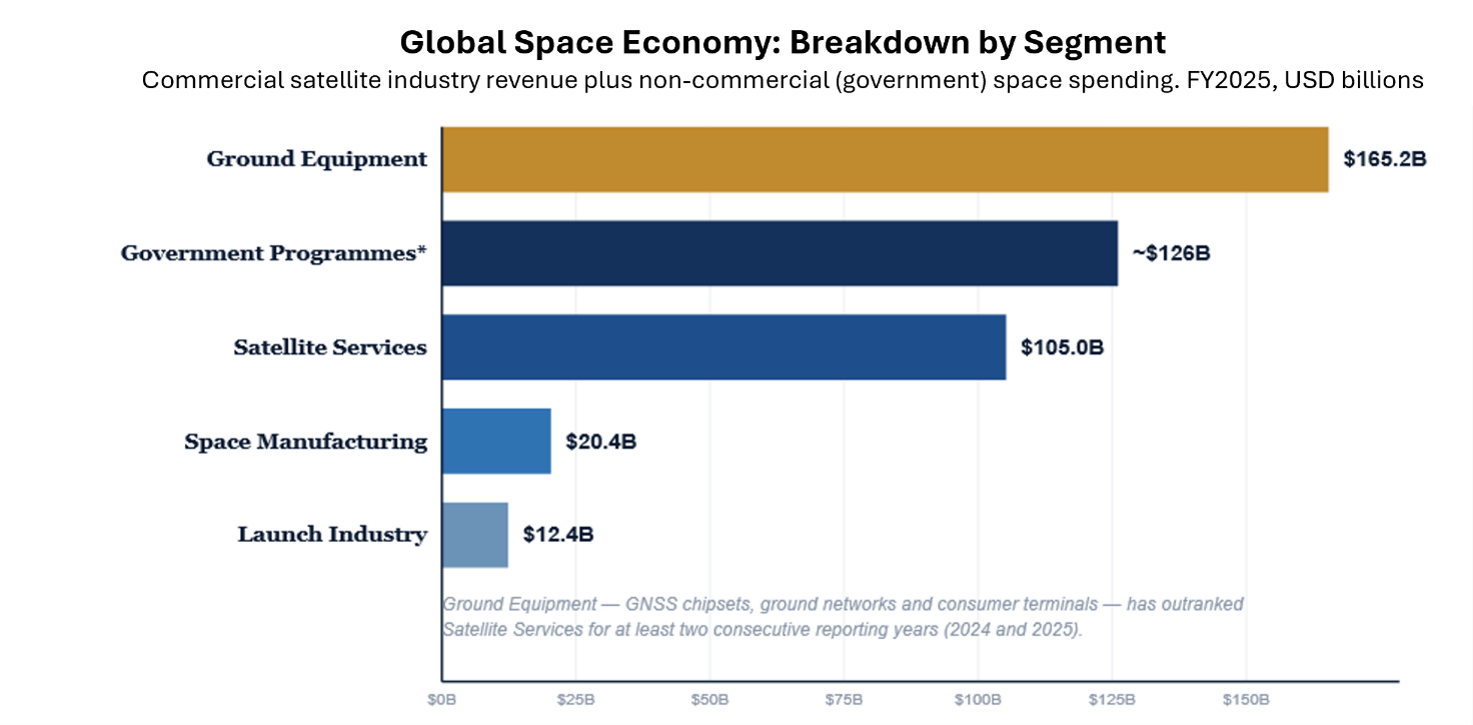
Source: Satellite Industry Association (SIA), 29th Annual State of the Satellite Industry Report, prepared by BryceTech (released 13/5/2026, FY2025 data). * Government Programmes is shown as a residual figure (total space economy less commercial satellite industry revenue, per SIA/BryceTech methodology) rather than an independently itemised line. This should be treated as directional, and not as precise. Space Sustainability activities (~USD 0.5 billion in 2025) are excluded from the chart for legibility but are the fastest-growing segment by percentage
Space Foundation's 2025 reporting indicates that the space economy has moved decisively past the $600 billion mark, with commercial activity now driving nearly four-fifths of total value.
The word “NewSpace” has now become commonly used to describe this commercial transformation. It refers to the new generation of privately funded commercially oriented space companies that have disrupted the previously government-dominated sector. SpaceX is the most visible example globally, but NewSpace encompasses hundreds of smaller companies across every part of the value chain: satellite manufacturers, launch service providers, data analytics firms, ground station operators, in-orbit servicing companies, and the growing ecosystem of insurance, finance, and legal services that supports all of them.

Source: Author’s illustration for Naka Space Advisory, based on OECD, ESA, Space Foundation, World Economic Forum and NewsSpace industry literature (NakaSA original 2026)
None of this operates in isolation. Every stage of the value chain draws on a common layer of enabling technology, and a supporting ecosystem of finance, insurance, legal and advisory services that makes commercial activity at this scale possible.
The African dimension: USD 24.95 Billion (and accelerating)
Africa's space economy is a subset of the global figure, and it’s growing fast. It has structural characteristics that make it particularly relevant to South African practitioners.
Space in Africa, the continent's leading space industry intelligence firm, published its African Space Industry Annual Report in late 2025 with a striking finding:
The African space economy was valued at USD 24.95 billion in 2024, and is projected to reach USD 39.52 billion by 2030, at a compound annual growth rate of 7.97%. This is significant as it indicates the pace has already outrun the industry's own forecasting, and the 2024 valuation beat Space in Africa's 2022 projection two years ahead of schedule. There are currently more than 300 active commercial space companies operating across 36 African countries. African governments collectively allocated USD 426 million to space activities in 2025. Between 1998 and 2025, 65 satellites were launched by or on behalf of African nations, with a further 105 planned between 2023 and 2026. The continent's satellite manufacturing pipeline spans 13 countries.
The drivers of this growth are primarily practical rather than aspirational.

Source: Africa Space Industry Report 2025, SpaceMart.
- Satellite-enabled services underpin telecommunications in regions where terrestrial infrastructure is absent or unreliable.
- Earth observation data supports agricultural planning, disaster management, border monitoring, maritime surveillance, and environmental compliance reporting.
- Navigation services drive logistics, transport, and financial inclusion programmes.
The 2024 submarine cable outages in West Africa demonstrated an important point: countries with diversified connectivity, including satellite backup capacity, weathered the disruption fastest, while several countries reliant on a single cable route faced extended blackouts.
The African Space Agency (AfSA) was formally inaugurated in Cairo on 20 April 2025, with a mandate to coordinate space activities across all 55 African Union member states, harmonise national space legislation, and represent African interests in international space forums. AfSA’s establishment certainly marks a turning point in that the legal and regulatory harmonisation work it is mandated to carry out will generate policy, legislative drafting, and compliance advisory work across the continent for years to come.
South Africa: Perhaps the continent's most developed space jurisdiction
South Africa occupies a distinctive position within this continental landscape. It is probably the most developed space nation on the continent in terms of regulatory framework, institutional capability, and private sector depth.
- South Africa has the most sophisticated space regulatory architecture on the African continent, anchored by the Space Affairs Act 84 of 1993 and administered through the South African Council for Space Affairs (SACSA), whose 15-member Council was reconstituted in February 2026.
- The South African National Space Agency (SANSA) operates internationally, with its Hartebeesthoek ground station supporting tracking and telemetry operations for agencies including NASA and ESA.
- The Square Kilometre Array, headquartered in South Africa and co-hosted with Namibia, is one of the largest scientific infrastructure projects in the world.
The private sector is where the most commercially significant activity is concentrated. CubeSpace, based in Stellenbosch, manufactures satellite attitude determination and control systems for international missions. Dragonfly Aerospace designs and builds imaging payloads for small satellites and has attracted significant international investment. NewSpace Systems manufactures reaction wheels and other spacecraft components, exporting to more than 30 countries across six continents. These are established manufacturers operating in international supply chains, not early-stage start-ups, and they generate export control, trade compliance, and supply chain liability questions almost on a daily basis.
South Africa's geographic position is also a commercial asset. The Overberg Test Range in the Western Cape is the site of South Africa's existing aerospace test infrastructure. A newly commissioned gantry at Overberg successfully launched its first test sounding rockets in December 2024, built by the University of KwaZulu-Natal's Aerospace Systems Research Institute (ASRI). Denel's corporate plan for the Overberg Test Range targets readiness for orbital satellite launch by 2028, with SANSA involved as a technical partner, and there is credible international interest in using Overberg as a commercial launch corridor. When that activity scales, it will generate a substantial volume of legal work in licensing, environmental compliance, liability structuring, and international treaty compliance.
South Africa is also navigating some of the most complex geopolitical tensions in the global space sector simultaneously.
- It is a Wassenaar Arrangement member, subjecting its exports of dual-use technologies to multilateral controls.
- It has signed onto the International Lunar Research Station, a Chinese and Russian-led lunar programme, stated to be in direct opposition to the US-led Artemis Plan and Artemis Accords.
- It hosts a joint South Africa-Russia space debris tracking facility at Hartebeesthoek.
- And it is one of the most active African nations in the Committee on the Peaceful Uses of Outer Space, the UN body that governs international space law.
These affiliations create a legal and compliance environment of genuine complexity for companies operating in the sector, and for the advisors who serve them.
Who are the players? (A reference framework for legal practitioners)
For a legal practitioner encountering this sector for the first time, the institutional maps below are a useful starting reference.
Table 1: The space activities legislative framework in South Africa, and its international obligations
| Regulatory bodies | International obligations |
|---|---|
| Department of Trade, Industry and Competition (the DTIC) | Outer Space Treaty (1967) |
| Independent Communications Authority of South Africa (ICASA) | Liability Convention (1972) |
| National Conventional Arms Control Committee (NCACC) / Directorate for Conventional Arms Control (DCAC) | Registration Convention (1976) |
| International Trade Administration Commission (ITAC) | Rescue Agreement (1968) |
At the international level, the United Nations Office for Outer Space Affairs (UNOOSA) in Vienna administers the international space treaty framework and maintains the register of space objects launched into orbit. The International Telecommunication Union (ITU) in Geneva manages the global spectrum and orbital slot coordination system, through which every satellite obtains the right to use specific radio frequencies and operate from specific orbital positions. The Committee on the Peaceful Uses of Outer Space (COPUOS) is the UN body through which states negotiate and develop international space law (South Africa is a full member).
At the continental level, AfSA coordinates African space activities and represents African interests in international space forums. The African Union's Space Policy and Strategy, adopted in 2016, provides the political framework. Regional economic communities, including the Southern African Development Community (SADC), Economic Community of West African States (ECOWAS), and the East African Community (EAC), increasingly play a role in sub-continental space policy coordination.
At the national level in South Africa, three institutions matter most for legal practitioners. SACSA licenses and supervises space activities under the Space Affairs Act. SANSA promotes space science and technology, operates ground infrastructure, and interfaces with international agencies, but holds no licensing authority. ICASA handles spectrum licensing for satellite communications, ground stations, and communication payloads under the Electronic Communications Act. In addition, the National Conventional Arms Control Committee (NCACC) and its Directorate for Conventional Arms Control regulate the export of dual-use technologies with defence applications, which includes a significant subset of space technology.

Conclusion
What does this mean for legal practitioners moving forward?
The dynamic space sector is arguably already a real present concern for South African legal practitioners. The companies, institutions, and regulatory bodies described in this blog are very active today, generating commercial relationships, compliance obligations, and disputes that require legal expertise.
The legal practitioner who understands this landscape has a genuine advantage. Space law itself is not an exotic specialisation requiring years of study; the real skill is recognising when a client's ordinary commercial matter has crossed into space sector regulatory territory – this may be an area almost no South African practitioner has trained for, especially as the market demand grows.
The next blog in this series examines the compliance frameworks themselves: the laws, treaties, standards, and regulations that govern this sector, what they require of the companies operating in it, and what they require of the legal advisors who serve those companies.
The third blog explores the specific gaps in South Africa's current regulatory environment, the risks those gaps create, and the emerging advisory opportunities they represent for practitioners who are ready to engage with them.
Legal practitioners who understand where this industry sits, and what it requires, are better placed to serve clients who are already operating inside it. You can upskill by attending the Space – satellite component compliance and regulatory practice for legal practitioners course offered by the Gawie le Roux Institute of Law in partnership with NakaSA.
About the Author

Natasha van Rooyen is the founder and principal of Naka Space Advisory (NakaSA), a South African space industry compliance and regulatory strategy practice. She holds observer status on the NASA-AIAA Mass Properties for Space Controls standards review committee, is an affiliate of the American Institute for Aeronautics and Astronautics Space Sustainability Task Force, a member of the AIAA-Sustainable Aviation Integration Committee, an associate of the African Astronomical Society, and a member of South African Women in Science and Engineering, lecturing also for the African Space Leadership Institute. Her various published works include the ITAR Field Guide for African Space Companies, the Space Industry Insurance Guide for South Africa, and multiple open-access research papers on Africa's space sector regulatory landscape. She is based in the Western Cape.
Last updated on 3 August 2026