


In the first blog in this series, we mapped the space industry landscape: what it is, how large it has become, who the key players are, and touched on South Africa’s significant position in it. That map is important context as regards terrain – but the rules present some complexity (and some risk) for a range of stakeholders.
This blog sets out the compliance framework that governs space sector activity in South Africa. It serves as a structured introduction to give legal practitioners an overview of the types of specialist knowledge needed, and the frameworks your client sees as important.
The framework
The framework has four layers, which all operate simultaneously. For instance, a company that correctly handles its export control obligations on one hand, might still be exposed or in breach of its ITU spectrum licensing requirements on the other; or, a company that holds a valid SACSA launch licence may still have failed to manage its obligations under the Liability Convention. Thus, understanding each layer and how they interact is the foundation of any credible space sector compliance practice.

It helps to think of the four layers not as a checklist to be worked through in sequence, but as a set of overlapping filters, each of which can independently block a transaction, generate liability, or create a market access barrier.
1. Layer one: International trade law
The World Trade Organization's General Agreement on Trade in Services (GATS) is the primary international trade law instrument relevant to space sector service providers. For example, when a South African Earth observation company sells data analytics to a Nigerian government agency, it is providing a cross-border service under GATS Mode 1. The market access conditions that apply, the obligations of both the service provider and the recipient country, and the dispute mechanisms available if those conditions are breached, are all governed by GATS, not by an ordinary commercial services contract.
At the continental level, the African Continental Free Trade Area is reshaping how space-related goods and services move across African borders. The AfCFTA Digital Trade Protocol, adopted by the AU Assembly in February 2024, will, once fully in force, govern cross-border data flows, e-commerce, and digital services – which, for the space industry, is represented by Earth observation analytics, satellite connectivity, and navigation applications.
As of July 2026, the Protocol has not yet entered into force, but its trajectory is clear, and legal practitioners advising companies in this space should be designing commercial arrangements that anticipate its obligations.
For legal practitioners, the trade law dimension most commonly surfaces in these situations:
- Advising on market access conditions for a client trying to provide satellite services in a foreign country;
- Structuring data licensing agreements that will need to comply with cross-border data obligations under POPIA and future AfCFTA provisions; and
- advising on whether a government's licensing requirements for a foreign satellite operator are consistent with its WTO commitments.
All these require a working knowledge of GATS. Knowing the trade law obligations is only part of the picture, because the most consequential compliance exposure in this sector doesn’t necessarily come from trade law at all.
2. Layer two: Export controls
Export controls are the layer where the consequences of non-compliance are most severe. They include criminal liability, not merely regulatory fines or civil claims. The most consequential export control regime is not South African at all – it’s American – but they apply to South African companies and individuals.
- The International Traffic in Arms Regulations (ITAR), administered by the US Department of State's Directorate of Defense Trade Controls (DDTC), govern the export of defence articles and services listed on the US Munitions List. For the space sector, the most relevant categories are:
- Category IV, covering launch vehicles and missiles, and
- Category XV, covering spacecraft systems and associated equipment.
ITAR applies extraterritorially: a South African company that incorporates a US-origin component into a satellite it manufactures is subject to ITAR, regardless of where the satellite is built or operated. Similarly, a South African engineer who is given access to ITAR-controlled technical data, whether in South Africa or abroad, is subject to what is known as a 'deemed export', treated in law as an export to that person's country of nationality. - The Export Administration Regulations (EAR), administered by the US Department of Commerce's Bureau of Industry and Security (BIS), apply to dual-use items on the Commerce Control List. Many commercial satellite components, ground station equipment, and related software fall under EAR rather than ITAR. The licensing processes, the available exemptions, and the enforcement consequences differ between the two regimes.
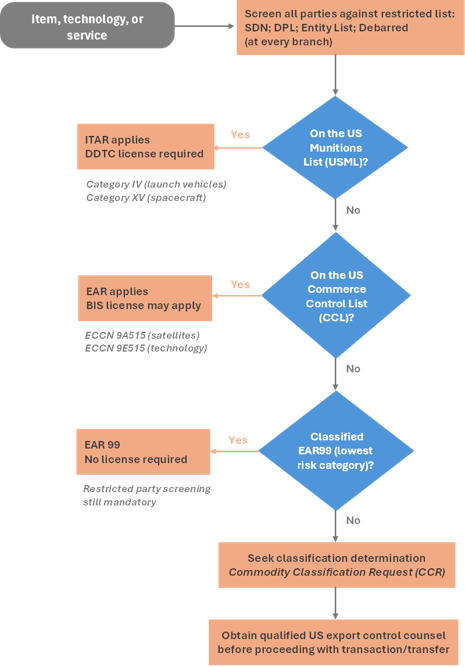
Diagram 2: NakaSA ITAR/EAR Decision Map (Adapted from the NakaSA Self-Assessment Toolkit - Naka Space Advisory. Not legal advice. Consult qualified export control counsel for specific transactions.)
ITAR follows the tech, not the geography. A South African company incorporating a US-origin component into a satellite it manufactures is subject to ITAR, regardless of where the satellite is built or operated. Criminal penalties for violations reach USD 1 million per violation.
- South Africa's domestic export control framework is administered by the National Conventional Arms Control Committee (NCACC) and its operational arm, the Directorate for Conventional Arms Control (DCAC). Under the National Conventional Arms Control Act 41 of 2002, no person may trade in conventional arms, including dual-use goods and services with defence applications, without NCACC registration and permit approval at each stage of the transaction: marketing, contracting, and export or import separately. Importantly, registration with the NCACC is a prerequisite for any subsequent permit application. A company that has not first obtained registration status cannot lawfully apply for a marketing, contracting, or export permit, regardless of the nature of the transaction.
The NCACC’s current operational state is directly relevant to any practitioner advising a client in the defence-adjacent space sector. The DCAC permit system was offline from 9 January 2026 due to a hardware failure during a system migration and was not restored until 13 March 2026. During that period, permit issuance came to a complete standstill. The Aerospace, Maritime and Defence Industries Association of South Africa (AMD) reported to Parliament in February 2026 that only seven NCACC meetings were held in 2025, with none from November onward, creating what it described as a three- to four month annual decision vacuum.
AMD estimated that NCACC delays had contributed to an estimated USD 8 billion in lost industry opportunities. The system has been restored as of July 2026, but the backlog from the January to March period remains material, and permit processing timelines should be built into any commercial contract that depends on NCACC approval.
Where export controls govern what can be transferred and to whom, the next layer addresses something equally fundamental: the legal framework that determines what can be done in space in the first instance, and who bears responsibility when things go wrong.
3. Layer three: International Space and Telecommunications Law
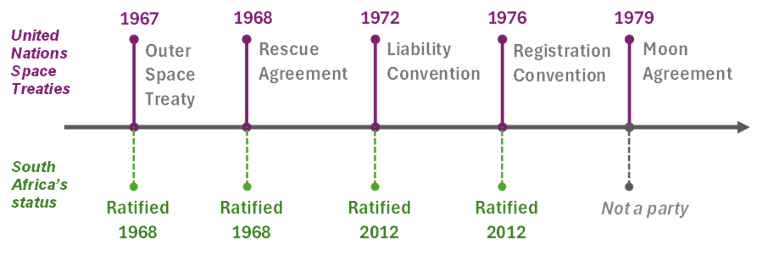
The foundation of international space law is five United Nations treaties negotiated between 1967 and 1979. South Africa has ratified four of them:
- The Outer Space Treaty (1967);
- The Liability Convention (1972);
- The Registration Convention (1976); and
- The Rescue Agreement (1968).
- South Africa has not ratified the Moon Agreement (1979), which has limited ratification globally and limited practical significance at present.
- The Outer Space Treaty is the document of international space law. Its Article VI is the provision most directly relevant to legal practitioners: it requires states to authorise and continuously supervise the space activities of their nationals, including private companies. This obligation cannot be delegated to another state. If a South African company launches a satellite and the launch provider is based in another country, South Africa's Article VI responsibility for that satellite's conduct in orbit remains binding.
- The Liability Convention establishes that the launching state bears absolute liability for damage caused by a space object on the surface of the Earth. The practical consequence for South African practitioners is significant: if a client's satellite, or a satellite launched from South African soil, causes damage, the South African state may face an international liability claim, and contractual arrangements between the client and the state need to address how that exposure is allocated and indemnified. For example, the Cosmos 954 incident in 1978, in which a Soviet satellite fell on Canadian territory, generated a claim that was settled for CAD 3 million. As commercial launch activity from Overberg increases, structuring appropriate indemnity and insurance arrangements becomes a live advisory task for South African practitioners.
- The Registration Convention (1976) requires states to maintain a national registry of objects launched into outer space and to furnish that information to the United Nations. For legal practitioners, the registration obligation is relevant in two situations. First, when advising a client on a satellite programme, confirming that the object will be registered by the appropriate launching state is part of basic due diligence, since an unregistered satellite has no internationally recognised legal status and its operator cannot assert spectrum or orbital rights through the ITU system. Second, registration records are publicly accessible through UNOOSA's online registry and can be used to verify the legal status of a space object in a commercial dispute or insurance claim.
- The Rescue Agreement (1968) obliges states to assist astronauts in distress and return space objects found on their territory. Its direct relevance to commercial practitioners is limited at present, though it becomes more pertinent as commercial human spaceflight develops.
- The ITU Radio Regulations are a binding international treaty that governs how the electromagnetic spectrum and orbital positions are coordinated globally. Every satellite must operate on frequencies that have been coordinated through the ITU system and registered in the Master International Frequency Register. The coordination process is technically complex, expensive, and time-consuming. It is administered in South Africa by ICASA on behalf of the state. African states face a structural disadvantage in this system because the ITU's first-come, first-served principle rewards institutional speed and continuity, and many African administrations lack the technical capacity and financial resources to file and defend coordination requests against established space nations with decades of filing history. The ITU Radio Regulations 2024 edition, updated after the World Radiocommunication Conference of 2023 (WRC-23), is the current governing instrument.
Even a company that has navigated trade law, export controls, and the international treaty framework correctly can still find itself locked out of the market, because the next layer – standards, quality management, and sustainability – which are not necessarily legal obligations, stands firmly as a commercial prerequisite.
4. Layer four: Standards, quality management, and sustainability
The fourth layer of the compliance framework is perhaps a lesser-explored legal layer, but more likely to carry higher value and risk for a client in commercial transactions. International standards are not merely technical documents. In the space sector, they function as market access conditions: a company that cannot demonstrate certification to the relevant standard is often structurally disqualified from bidding on international supply chain contracts, regardless of its technical capability.
The typical international standards faced by South African space companies are listed below:
| ISO 9001:2015 | The foundational quality management system standard, the internationally recognised baseline that signals organisational credibility to partners, investors, and customers. |
| AS9100 Rev D | The aerospace and defence sector extension, incorporating additional requirements for risk management, configuration management, and product realisation controls specific to aviation, space, and defence. Many European and North American prime contractors require AS9100 certification as a non-negotiable supply chain qualification condition. An African component manufacturer that cannot demonstrate AS9100 certification is, in practice, locked out of those supply chains regardless of price or quality. |
| ISO 24113:2023 | The international standard for space debris mitigation requirements. Published in its fourth edition in May 2023 and adopted by ESA through its own ECSS standard in February 2024, it requires satellite programmes to demonstrate, from the earliest design phase, that the spacecraft will be disposed of within 25 years of end of mission, that residual propellants will be vented at end of life, and that the probability of a member of the public being harmed by re-entry is below 1 in 10,000. European launch providers now require demonstrated ISO 24113 compliance as a launch manifest condition. For a South African client developing a satellite programme that will use a European launch vehicle, ISO 24113 compliance is not optional. |
For legal practitioners, the standards layer most commonly creates advisory work in three areas:
- reviewing supply agreements that impose standards certification requirements on a client and assessing whether the client can meet them;
- structuring investor due diligence processes that include quality system verification; and
- advising on the professional risk of overstated SDG or sustainability claims, which is a growing area of exposure as development finance institutions increase the rigour of their sustainability reporting requirements.
The compliance landscape in practice
The following table summarises the key instruments in each compliance layer, the South African regulatory authority or international body responsible, and the primary type of legal advisory work each generates. (It’s designed as a quick reference, not a comprehensive guide.)
| Layer | Key instrument | Authority | Primary legal work generated |
|---|---|---|---|
| International Trade Law | WTO GATS; AfCFTA Digital Trade Protocol; POPIA | WTO; AfCFTA Secretariat; Information Regulator (SA) | Market access conditions; data licensing; cross-border transfer compliance; POPIA operator agreements |
| Export Controls | ITAR (22 CFR Parts 120-130); EAR (15 CFR Parts 730-774); NCACC Act 41/2002 | DDTC (US State Dept); BIS (US Commerce); NCACC/DCAC (SA) | Supply contract review; deemed export advisory; Technical Assistance Agreements; NCACC permit applications; voluntary self-disclosure |
| Space and Telecomms Law | Outer Space Treaty 1967; Liability Convention 1972; ITU Radio Regulations 2024; Space Affairs Act 84/1993 | UNOOSA; ITU; SACSA; ICASA (SA) | Launch liability structuring; indemnification agreements; SACSA licensing; spectrum compliance; insurance coverage review |
| Standards and Sustainability | ISO 9001:2015; AS9100 Rev D; ISO 24113:2023; COPUOS LTS Guidelines 2019 | SABS (SA); IAQG; ESA/ECSS; COPUOS | Supply agreement quality requirements; investor due diligence; SDG reporting compliance; insurance condition review |
The current risks and opportunities for legal practitioners
The compliance framework described above further creates four classes of risk for South African legal practitioners – but also corresponding types of advisory opportunity.
The first risk is recognition. A practitioner needs to have a framework in place to advise a client of their regulated environment. For instance, a commercial contract may seem straightforward enough, but may conceal ITAR obligations, ITU coordination requirements, or NCACC permit conditions. The practitioner should be in a position to recognise these kinds of red flags.
The second is drafting – where contracts in this sector need clauses that might not be routine drafting, i.e. export control flowdown provisions, ITAR compliance warranties, satellite insurance requirements calibrated to the Liability Convention, spectrum licensing conditions, and quality system certification requirements – all exposing the client to risk.
The third is due diligence. Investors, acquirers, and development finance institutions are increasingly becoming educated about space sector compliance. A due diligence process ought to include export control history, NCACC permit status, ITU filing currency, and standards certification – all to create a complete picture of a target company's regulatory exposure.
The fourth risk class (and from a career positioning perspective, perhaps the most interesting) is opportunity. South Africa has arguably more sophisticated space sector infrastructure than any other country on the continent. We have fast-growing international space manufacturers and space companies. The Overberg commercial launch corridor is becoming a nationally invested development, and AfSA's continental harmonisation mandate will most certainly generate legislative drafting, policy advisory, and compliance framework work across 55 African Union member states over the next decade.
A legal practitioner who can establish and prove their advisory role within this evolving space regulatory framework will be a vital resource for our continental space ecosystem.
Conclusion
If you advise commercial, technology, defence, or regulatory clients, you are more likely than not to encounter a space sector matter in the next few years.
The Gawie le Roux Institute of Law, in collaboration with NakaSA, offers a practical, applied introduction to the regulatory frameworks governing space activity. The course is built for legal practitioners who already know how to read and apply the law, but have not yet encountered this specific regulatory terrain.
About the author

Natasha van Rooyen is the founder and principal of Naka Space Advisory (NakaSA), a South African space industry compliance and regulatory strategy practice. She holds observer status on the NASA-AIAA Mass Properties for Space Controls standards review committee, is an affiliate of the American Institute for Aeronautics and Astronautics Space Sustainability Task Force, a member of the AIAA-Sustainable Aviation Integration Committee, an associate of the African Astronomical Society, and a member of South African Women in Science and Engineering, also lecturing for the African Space Leadership Institute. Her various published works include the ITAR Field Guide for African Space Companies, the Space Industry Insurance Guide for South Africa, and multiple open-access research papers on Africa's space sector regulatory landscape. She is based in the Western Cape.
Scope notice
This blog is produced by Naka Space Advisory for general informational and educational purposes only. It does not constitute legal advice and may not be relied upon as such. Readers should obtain independent legal advice in relation to their specific circumstances. Naka Space Advisory is a space industry compliance advisory practice, not a registered legal practice. All regulatory references are current as at July 2026. Readers should verify the current status of all cited instruments independently before relying on them.
Last updated on 7 September 2026.