


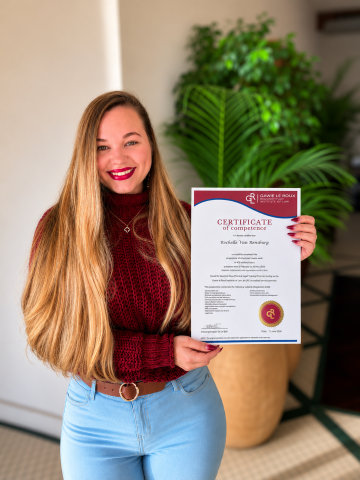
About Rochelle
"I am currently a Company Secretarial Administrator and Trust Specialist at Acute Accountants Inc. My work involves company secretarial compliance, shareholder records, CIPC matters, trusts, statutory records, resolutions and related compliance work."
On enrolling at the Gawie le Roux Institute of Law
"I chose Gawie le Roux Institute of Law after doing quite a bit of research into the different options available. I wanted a law school that would offer proper structure, quality material and a more interactive learning experience.
GLR seemed to offer a good balance between academic content and practical support. I did not want to feel as though I was simply working through material on my own. I wanted a programme that would help me understand the work properly, challenge me where necessary, and prepare me for the practical realities of the profession.
The student feedback and reviews also gave me confidence that it would be a strong choice. It came across as a law school that takes the training seriously, while still understanding that students need guidance, clarity and support."
400-hour vs 150-hour PVT programme of structured course work
"I chose the 400-hour practical vocational training programme because I wanted the most comprehensive foundation possible before writing my board exams. I wanted to genuinely understand the areas of practice that would be relevant to the exams and to future legal work.
The 400-hour programme appealed to me because it gives you more exposure to the material and more time to engage with the practical side of the profession. I knew it would be more demanding, but I also knew that I would rather do something properly than take the shortest route simply because it was available.
Another important factor was the flexibility it provides. With the 400-hour programme, candidates can write the board exams before completing their practical vocational training as candidate attorneys, instead of first having to complete six months before qualifying to write. That suited the way I wanted to structure my professional development: complete the training, prepare properly for the exams, write them, and then complete the required period of practical vocational training afterwards.
My experience of the lecturers was very positive. The slides and materials were well prepared, and I could see that a lot of thought had gone into structuring the information in a practical way.
I appreciated lecturers who explained things in a direct and practical way. Law can become very abstract if it is not taught properly, so it made a difference when lecturers broke things down clearly and gave context.
Something I found especially sincere was that some of the lecturers shared their email addresses with us and said that we were welcome to contact them even after law school, including later in our careers. I thought that was very heartfelt. It made the experience feel less transactional and more supportive, as though they genuinely wanted students to succeed beyond the programme itself."
The mock trial
"I found it intimidating at first, but also exciting. It forced me to engage with the material actively instead of just reading about it. It also showed me that legal practice requires more than knowledge. It requires composure, preparation, communication, strategy and the ability to think clearly under pressure.
The mock trial exercise was one of the most effective parts of the programme. It was challenging, but that is exactly why it was valuable. It is one thing to study litigation in theory. It is very different when you are expected to participate, think on your feet, ask questions and respond in the moment.
The exercise puts you outside your comfort zone very quickly, especially if you are nervous or not used to being placed on the spot. I had to cross-examine first, which made the experience even more intense. You can prepare your questions and understand the facts, but the preparation does not fully prepare you for what a witness might actually do or say. A witness may answer differently from what you expected, avoid the point, give an unexpected answer, or change the direction of your questioning completely. That creates real pressure.
That was one of the biggest lessons: you cannot prepare for every possible answer a witness may give. You still need to learn how to listen carefully, think quickly, adapt and improvise while staying composed. Cross-examination is not only about having a list of questions. It is about being present enough to respond to what is actually happening in front of you.
The mock trial was memorable because it felt real. It gave me a glimpse of the human side of litigation — the nerves, the unpredictability, the pressure and the importance of being properly prepared while still being flexible. I think exercises like that are incredibly valuable because they move students from passive learning into actual participation. It is the kind of skill you have to get used to and train into; you cannot fully learn it from a textbook alone."
Rochelle's tips for PVT students
- "My biggest practical tip would be to be honest with yourself about the level of commitment required. The 400-hour programme is absolutely manageable, but it is not something you can approach passively. There is a lot of self-study involved, and you need to take responsibility for your own progress.
- I would suggest creating a system from the beginning. Keep track of your hours, submissions, deadlines and completed work. Do not rely on motivation alone, because motivation will come and go. A proper routine and a clear plan will carry you much further.
- It also helps to treat the programme as preparation for practice, not just as a requirement to complete. The exercises are far more useful when you engage with them properly and ask yourself: 'How would this work in real life?' That mindset makes the content more memorable and more valuable.
- My final advice would be to ask questions. Stay curious and give yourself enough time to understand the material. You do not need to know everything immediately. You just need to keep showing up consistently and be willing to learn properly.
On facing challenges
"The workload was substantial, and there were times when I felt out of my depth. I was also working at the same time, so balancing my professional responsibilities with the demands of the programme was not always easy. There were periods where I needed a lot of time to go through the GLR material properly, and that placed pressure on my normal work responsibilities."
I think that is something many people experience but do not always say out loud.
It can be difficult to balance ambition with capacity. You want to do well, you want to keep up, and you want to prove to yourself that you are capable, but you also have to be realistic about the amount of work involved.
I handled it by focusing on the bigger picture and reminding myself why I had chosen the 400-hour programme in the first place. I wanted a stronger foundation, and that was going to require effort. I had to become more disciplined with my time, prioritise more carefully, and accept that growth often feels uncomfortable while it is happening.
The experience taught me a lot about resilience. It reminded me that confidence does not always come before you start something. Sometimes confidence is built while you are doing the difficult thing."
Rochelle's recommended reading for legal practitioners
"I think legal practitioners should read books that develop not only legal knowledge, but also judgment, communication, emotional intelligence and critical thinking. Law is ultimately about people, systems, conflict, fairness and decision-making, so I think a broad reading list is important.
Some books I would recommend are:
- Letters to a Law Student by Nicholas J. McBride
- The Rule of Law by Tom Bingham
- To Kill a Mockingbird by Harper Lee
- Thinking, Fast and Slow by Daniel Kahneman
- Getting to Yes by Roger Fisher, William Ury and Bruce Patton
A good legal practitioner needs to be analytical, but also human. You need to understand rules and procedure, but you also need to understand people, persuasion, negotiation and consequences. I think the best professionals keep developing both their technical ability and their way of thinking."
What's next?
"My next focus will be preparing for the board exams, and I intend to purchase the Attorneys' admission exam courses to support that process. I want to approach the exams properly and make sure that I give myself the best possible chance of succeeding.
I also plan to pursue a conveyancing course at some point, because I would like to continue broadening my practical legal knowledge. I am interested in building a strong foundation across different areas of practice, especially where law, commerce, compliance and practical problem-solving meet.
Lastly, I would like to pursue further upskilling in the use of AI within the legal environment, particularly where it can support accurate legal drafting, research and practical efficiency. I think technology will continue to shape the profession, and it is important for legal professionals to understand how to use it responsibly, ethically and effectively. Upskilling is not only about adding qualifications. It is about becoming more capable, more precise and more useful in the work I do. I want to keep growing into a professional who is both technically strong and practically effective."
Last updated on 24 June 2026.